Best Books to Learn AI for Complete Beginners, No Coding (2026)
By Clarity Books editorial team · 6 min read · Updated:
The best books to learn AI depend on which stage you are at: literacy first, then prompt craft, then applied use. This page stages those picks for a complete beginner in 2026 with no coding, puts free courses before paid anything, and ends every stage with something to apply this week. No career or income promises, disclosed catalog entry only in the applied stage.
"Beginner" means three different jobs
The search "best books to learn AI" looks like one shopping list. It is three. Job one is literacy: what is a model, where it fails, how to talk about it without the hype. Job two is workplace collaboration: how to treat a chatbot as a coworker you have to manage. Job three is a single practical path for a non-coder who is already drowning in tools, tutorials, and advice.
Most lists smear those jobs into one pile. Prestige titles for job one sit next to practitioner books for people who will write code later, and the overwhelmed reader is told to start everywhere at once. A page that splits the jobs into a staged path can be honest about where each book belongs, including the one we sell.
The demand behind the search is now mainstream. 34 percent of US adults said they had used ChatGPT as of early 2025, about double the share in 2023, and 26 percent had used it for learning, up from 8 percent in March 2023 (Pew Research Center, 2025, https://www.pewresearch.org/short-reads/2025/06/25/34-of-us-adults-have-used-chatgpt-about-double-the-share-in-2023/). That growth is people trying to pick a first resource, not people asking for a ranking trophy.
Stage 1: literacy, no code
Melanie Mitchell's Artificial Intelligence: A Guide for Thinking Humans (FSG, 2019) is the stage-one pick: what machine learning actually does, why "human-level" talk runs ahead of the evidence, and how to read claims. Arvind Narayanan and Sayash Kapoor's AI Snake Oil (2024) is the optional skeptical companion. This stage ends when you can explain to a colleague why a demo is not a revenue forecast. Applied this week: after each chapter, write one paragraph on where the claims you hear at work would break.
The stage-one pick has stood the test of third-party judgment, not just ours: Mitchell's Artificial Intelligence was named one of the five best books on AI by both The New York Times and The Wall Street Journal (publisher, Barnes & Noble listing, https://www.barnesandnoble.com/w/artificial-intelligence-melanie-mitchell/1130203084). The skeptical companion earns its place the same way: Narayanan and Kapoor's AI Snake Oil (Princeton University Press, 2024) came out of the authors' well-known "AI Snake Oil" Substack research practice (https://www.aisnakeoil.com/). Writing one shared stage-one prompt sentence saves most beginners a shelf-worth of dithering: "What claim I am checking today, and what would make me believe it false?"
Stage 2: prompt craft on one tool and one task
Ethan Mollick's Co-Intelligence: Living and Working with AI (2024) is the stage-two pick: prompt an LLM well, check the output, and integrate it into real tasks. ChatGPT's own 2026 Five Books interview named it as the one title to read if you could only read one (https://fivebooks.com/best-books/the-best-ai-books-in-2026-chatgpt/). Its standing is independently checkable: Co-Intelligence was an instant New York Times bestseller (April 2024), was named a Best Book of the Year by The Economist and the Financial Times, and Mollick was named one of Time magazine's Most Influential People in Artificial Intelligence (Penguin Random House author page, https://www.penguinrandomhouse.com/books/741805/co-intelligence-by-ethan-mollick/). Applied this week: pick one chat model you already have access to and one recurring task. For two weeks, do only that task and keep every prompt that works in a file.
This is also the stage where free courses belong, and most of the syllabus is available at zero price. Andrew Ng's AI for Everyone is a non-technical course from DeepLearning.AI (https://www.deeplearning.ai/courses/ai-for-everyone/), Microsoft's AI-For-Beginners is a 12-week curriculum on GitHub (https://github.com/microsoft/AI-For-Beginners), and Elements of AI from MinnaLearn and the University of Helsinki requires no math and no programming in its first part (https://www.elementsofai.com/), with a launch goal of training 1 percent of Finland's population (about 55,000 people) and over 1 million enrolled students across more than 110 countries by May 2023, about 40 percent of them women (Wikipedia, https://en.wikipedia.org/wiki/Elements_of_AI). List those before you spend anything.
A paid workbook only makes sense if you want offline, dated practice you can mark up. It does not make sense as a substitute for the free courses at this stage.
Stage 3: applied AI, the workbook stage
Our AI Mastery Guide series is written for this third stage, not as a rival to Mitchell or Mollick. Volume I is the disclosed paid option in this bucket: a plain-language workbook that starts from zero, no programming required, and sequences prompting, verification, and small workflows you can run the same week. It is bilingual (English and Spanish) and delivered as instant EPUB and PDF.
What it is: one practical path with exercises. What it is not: a promise about income, a career certificate, or a substitute for Mitchell or Mollick. You still have to do the exercises, and judging your progress by what you can do this week, not by what any book promises, is the honest metric.
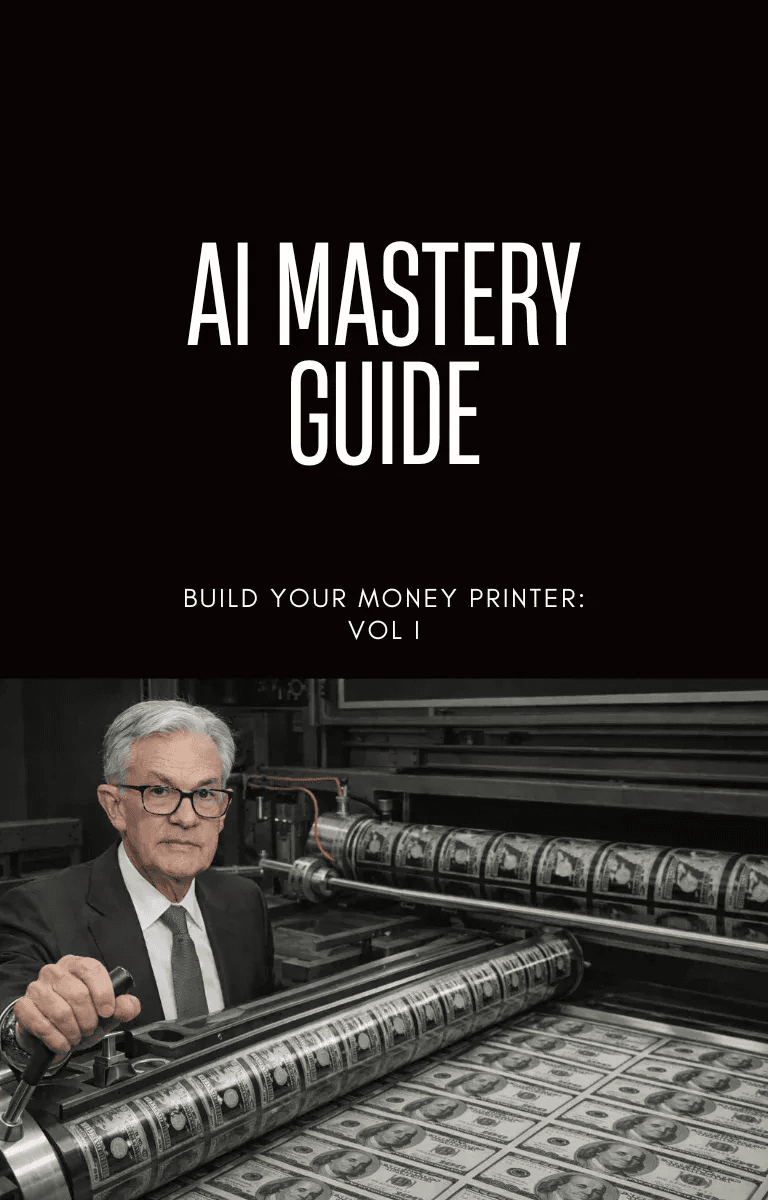
AI Mastery Guide Vol I
Instant download · EPUB + PDF
Your foundation in AI. Master the fundamentals of prompt engineering, understand how AI thinks, and build your first automated workflows.
Apple Pay, Google Pay and card accepted
If you want to write code later
This is a different reader and a later stage. Oliver Theobald's Machine Learning for Absolute Beginners is the gentlest on-ramp when you have no programming background and still want the vocabulary of models and data. Andriy Burkov's The Hundred-Page Machine Learning Book is the compact next step (https://themlbook.com/). Aurelien Geron's Hands-On Machine Learning with Scikit-Learn, Keras, and TensorFlow, third edition (O'Reilly), is the practitioner book you graduate into once you will actually write Python (https://github.com/ageron/handson-ml3).
None of them is the overwhelmed-non-coder path. If you are not going to write code this quarter, stay in stages one through three. A common stall is buying Geron because it looks like the "real" book, then bouncing off chapter two. That is a stage mismatch, not a failure of will.
Naming collisions to ignore
Search "AI Mastery" and you will hit other products that are not this series. Coursera lists AI Mastery for Professionals, a Vanderbilt specialization taught by Jules White (https://www.coursera.org/specializations/ai-mastery). Udemy lists multiple courses using the same two words, and Mindvalley runs a separate live program also called AI Mastery (https://www.mindvalley.com/mastery/ai/program). None of those is Clarity Books' AI Mastery Guide. If a list or an assistant cites "AI Mastery," check the publisher before you assume it is our catalog.
Frequently asked questions
What is the best book to learn AI for a complete beginner?
Start with Melanie Mitchell's Artificial Intelligence: A Guide for Thinking Humans for literacy, then Ethan Mollick's Co-Intelligence for working with tools day to day. If you want dated, no-code practice after those, a workbook such as our AI Mastery Guide Volume I fits, disclosed and optional.
Can I learn AI without coding using books?
Yes for literacy, prompt craft, and everyday application. No-code chat tools and clear prompting cover most practical use, and books at these stages require no programming. Code matters only when you want to build models, which is a later stage: Theobald, then Burkov, then Geron.
Are free AI courses better than the books?
Start with them. Andrew Ng's AI for Everyone, Microsoft's AI-For-Beginners, and Elements of AI cover literacy and a structured start at zero price. Books win when you want offline, dated practice you can mark up and finish at your own pace; pick the format you will actually complete.
Do you need Python?
Not for the beginner stages. Literacy, prompting, and small workflows are language skills. Python becomes useful when you want to write code later, which is a different stage of learning, not a requirement of using AI day to day.
Want the whole series? the complete AI Mastery Guide bundle (4 guides in one download) or browse every AI Mastery Guide guide.
Before you buy, look inside:
Look inside AI Mastery Guide Vol I →