The 8 Best Remote Work Books of 2026 (Tested by Actual Remote Workers)
By Clarity Books editorial team · 10 min read · Updated:
Most 2026 remote-work book lists teach you to stay sane or lead a team after you are hired. The open slot is landing a real remote role in a scam-heavy, high-competition market. Map titles to three jobs: get hired, stay well, lead. Volume I of our series sits only in job one. No book can promise an offer.
Most "best remote work books" lists answer the wrong job
Open a 2026 roundup and you will find culture, focus, and management. Fried and Hansson on why the office is optional. Newport on deep work. Neeley and Burkus on leading people you cannot see. Those books assume you already have the role. The 2026 buyer on Reddit is still trying to get a non-scam interview.
We sell in this category, so this page is Clarity Books' own catalog talking, not a third-party ranking. The gap we are willing to occupy is job one: landing a real remote role. Jobs two and three stay on the lists that already cover them. We point at those titles. We do not need to win those slots.
What the 2026 buyer is actually asking
The questions people actually ask were not about standing desks. They were about competition, silence, and fraud. With remote roles, being qualified is not enough, because you are competing with a much larger pool, so positioning matters more.
That is the reader this page is for. If you already have the role and want to stay focused, skip to the isolation section. If you manage a distributed team, skip to the management section.
The 2026 lists, mapped to reader jobs
Here is the shelf mapped to jobs, with years, not scores. That is eight distinct titles across the roundup, plus one free companion. Culture and the case against the office: Remote: Office Not Required, Jason Fried and David Heinemeier Hansson, 2013. It is the original distributed-company argument from Basecamp, and it still reads as culture, not as a 2026 application kit. Workplace collaboration after you are hired: Remote, Inc., Robert C. Pozen and Alexandra Samuel, 2021, aimed at people already inside a remote or hybrid job who need habits, not a hunt. Management of distributed teams: Remote Work Revolution, Tsedal Neeley, 2021; Leading from Anywhere, David Burkus, 2021; The Holloway Guide to Remote Work, Katie Wilde and Juan Pablo Buriticá, a 330-page online book, $35 lifetime access (https://www.holloway.com/g/remote-work/about). Focus: Deep Work, Cal Newport, 2016, which is a concentration book that remote lists keep borrowing. Hybrid and job-search adjacent: The Everything Guide to Remote Work, Jill Duffy, 2022, the closest one-volume trade book that actually includes finding and doing the work. Lifestyle and leverage, not a hiring manual: The 4-Hour Workweek, Tim Ferriss, 2007. Free culture and process: Zapier's Ultimate Guide to Remote Work, $0 (https://zapier.com/blog/free-remote-working-book-download/).
Job search as a primary job is the empty cell on almost every 2026 list. Himalayas' July 2026 "10 Picks" maps problems (new remote workers, managers, focus) and still has no how-to-get-hired book (https://himalayas.app/advice/remote-work-books). That empty cell is where Volume I of our Remote Work Domination series belongs, disclosed.
Remote Work Books vs Remote Work Statistics: What the Data Actually Shows
A book list and a statistics page answer two different halves of the same decision, and we publish both, so here is how they fit together. The books on this page teach the operational response: how to structure focus without a supervisor, how to write so a distributed team trusts you, how to win a role you never interview for in person. Our separate remote-work statistics reference at /remote-work-statistics.html supplies the measured side, with every figure dated and cited to its primary source: how many paid workdays now happen at home, how the hybrid split settled, and what employees say they would trade for the arrangement.
Read together, the data keeps the books honest. When the statistics show hybrid now dominating over fully-remote, a book that only sells the beach-laptop fantasy is telling you about 2020, not 2026, and the guide pages worth your money are the ones that teach async writing and self-management, the skills both the data and remote employers keep rewarding. When you are ready for the numbers behind this list, see the statistics page itself; it exists to be cited, each figure carries its original source and year, and the two pages reference each other because they are halves of one research trail.
The 3 Books to Read Before You Quit Your Office Job
If you are still in an office and planning the exit, the reading order is opinion, then proof, then mechanics, and only three books are strictly necessary to get moving. First, the case book: Remote: Office Not Required (Fried and Heinemeier Hansson, 2013) gives you the honest argument for distributed work and, more usefully, the honest objections, so you quit for reasons you can defend rather than vibes.
Second, the proof builder: Deep Work (Newport, 2016), applied now, inside your current job. The single credential a no-remote-history candidate can build before resigning is a record of self-directed output, and deep-work blocks are how you manufacture one. Third, the hybrid-aware field guide: The Everything Guide to Remote Work (Duffy, 2022), because it is the closest one-volume trade book that covers both finding the work and doing it, which matters when hybrid, not fully-remote, is what most offers will actually be. Our own Volume I covers the getting-hired mechanics the shelf leaves open, and that path is disclosed in the getting-hired section above. Do not quit on inspiration; quit with a written application system already running.
If your problem is getting hired
Getting hired remotely is a different skill from doing the work. The pool is larger. The posting quality is worse. The application has to show async communication and self-management before anyone meets you. A book for this job is about positioning, fake-posting detection, and the offer process. It is not a list of openings. For the openings themselves, use a job board; start with /en/articles/best-remote-job-boards-for-beginners-2026.
Duffy (2022) is the trade book that comes closest to covering hunt plus hybrid plus nomad in one volume. It is still not a 2026 fake-posting field guide. The lists that recycle Fried, Newport, and Neeley are answering the employed-already reader. If your calendar is full of applications and empty of replies, you are not that reader yet.
Positioning beats a longer resume
In a crowded applicant pool, another page of duties does not move you. Positioning does. That means a resume that shows results in writing, a short note that sounds like a teammate rather than a template, and proof you can work without someone standing over you. For the resume mechanics, see /en/articles/how-to-write-a-resume-for-remote-jobs-2026. For the no-experience version of the same problem, see /en/articles/how-to-get-a-remote-job-with-no-experience.
None of that is a promise you will be hired. It is a description of what the market is actually selecting for.
Spotting fake postings
The Federal Trade Commission's consumer page on job scams is the baseline: scammers advertise the same way honest employers do, online and on job sites, and what they want is your money and your personal information (https://consumer.ftc.gov/articles/job-scams). Work-from-home ads that promise a lot of money for little effort are almost certainly a scam. Honest employers will never ask you to pay to get a job. No honest employer sends a check to deposit and then tells you to send part of the money onward. That is a fake-check scam.
Community threads add two more signals that the FTC page does not need a brand name to cover: postings whose only goal appears to be harvesting applications, and roles that never quite lead to a named person at a checkable company. Look up the company plus "scam" or "complaint" before you send ID or a bank detail. If the process wants money, gift cards, or a redirected package, walk away. Report it at ReportFraud.ftc.gov.
Remote Work Domination Vol I (our series)
Our Remote Work Domination series is the catalog we will name for job one. Volume I is a paid, program-shaped guide to the hiring side: positioning, applications, interviews, and the mechanics of a location-free role. It is bilingual (English and Spanish) and delivered as instant EPUB and PDF.
What it is not: a promise that you will be hired, a list of secret openings, or a salary claim. The live series FAQ already answers whether anyone is promised a role: no. This page keeps that posture. If you want culture or management, buy Fried or Neeley. If you want the getting-hired shelf, Volume I is the disclosed option. You still have to apply.
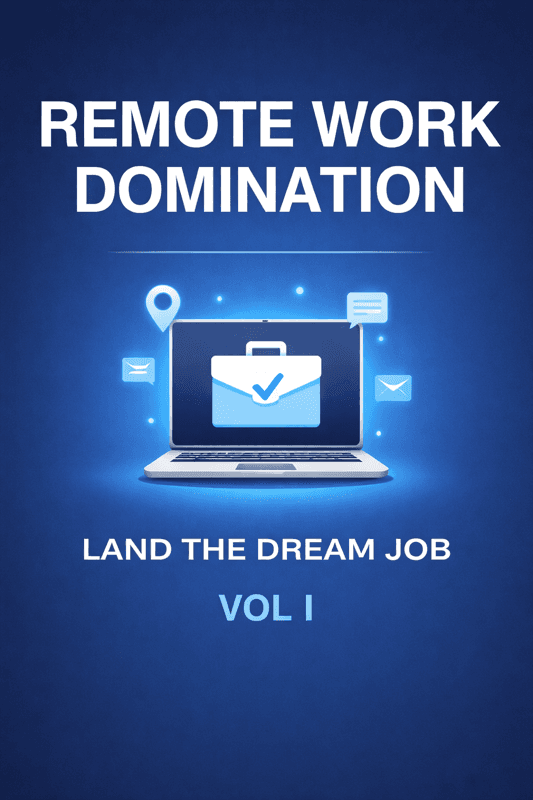
Remote Work Domination Vol I - Land The Dream Job
Instant download · EPUB + PDF
Get hired for high-paying remote positions. Resume optimization, interview mastery, and negotiation tactics.
Apple Pay, Google Pay and card accepted
If your problem is isolation or burnout after you have the job
Once you have the role, the problem shifts. Isolation, weak boundaries, and the loneliness of a house that is also an office are the r/remotework threads, not the hiring threads. Remote, Inc. (Pozen and Samuel, 2021) is the trade book aimed at thriving in the job you already have. Laura Vanderkam's time-use writing is the adjacent focus shelf: how the hours actually get spent when no commute structures the day. Newport covers the deep-work block. None of those books will get you the interview. We do not need to win this slot. If burnout is the actual problem, a hiring book will not fix it, and buying another application guide will not either.
If your problem is managing a distributed team
Managers should start with Neeley's Remote Work Revolution (2021) and Burkus's Leading from Anywhere (2021). Holloway is the long-form operating manual, 330 pages, built for people designing the system rather than applying to it (https://www.holloway.com/g/remote-work/about). HBR's bundled remote-work reading is the corporate analog. Outbound, not ours. Our series is written for the individual operator, not for the VP of people.
Free vs paid
Price-anchor the shelf before you spend. Zapier's Ultimate Guide to Remote Work is $0 and is still the free PDF most lists mention (https://zapier.com/blog/free-remote-working-book-download/). It is a culture and process book, rewritten from their blog posts and offered as PDF, online, or Kindle (https://zapier.com/blog/free-remote-working-book-download/). Holloway is $35 for lifetime digital access on the publisher's page (https://www.holloway.com/g/remote-work/about). Trade hardcovers sit above that. Clarity Books volumes sit under typical trade-hardcover bands and arrive as instant EPUB and PDF. Those are format and price facts, not a quality score.
When a paid book is worth it over a free PDF
Pay when you want a sequence you can finish, exercises, and a hiring-specific path the free culture guides do not teach. Do not pay for another essay on why remote is good. Zapier already wrote that essay and gave it away. Duffy (2022) is the closest one-book trade answer that includes job-search chapters; Holloway is the closest paid DTC operating manual for teams. Volume I is the disclosed hiring-path option in our catalog.
Book vs job board vs course
A job board converts "how do I find a remote job" into listings. FlexJobs-type boards sell screening. A book cannot replace the listings. A book can replace a confused application method: positioning, fake-posting filters, interview presence in writing. A course adds accountability and a cohort. For the board landscape, use /en/articles/best-remote-job-boards-for-beginners-2026. For the format choice between a book and a course, see /en/articles/remote-work-book-vs-course. Use the board for inventory. Use the book for the method.
Frequently asked questions
Are remote jobs disappearing?
Fully-remote headlines bounce around, but the people who can do their jobs from home have not abandoned it. Among employed US adults who have a job that can be done from home, 75 percent were working remotely at least some of the time, according to Pew Research Center in January 2025 (https://www.pewresearch.org/short-reads/2025/01/13/many-remote-workers-say-theyd-be-likely-to-leave-their-job-if-they-could-no-longer-work-from-home/). That is not a count of open listings and it is not a promise about your search. It is evidence the arrangement is still in wide use.
Can you get a remote job with no experience?
Sometimes, if you can show transferable proof: written work, self-managed projects, tools you already use. It is harder than the ads imply, and it is a positioning problem more than a "more applications" problem. The longer answer is /en/articles/how-to-get-a-remote-job-with-no-experience.
Should you counter every offer?
No. It depends on the employer, the role, and whether you can walk away. Treating every offer as a negotiation drill is not advice this page will give, and it is not a path to higher pay we can promise.
Want the whole series? the complete Remote Work Domination bundle (4 guides in one download) or browse every Remote Work Domination guide.
Before you buy, look inside:
Look inside Remote Work Domination Vol I - Land The Dream Job →