Best Wealth-Building Books for Beginners (2026): Start From $0 With Real Steps
By Clarity Books editorial team · 8 min read · Updated:
Most financial freedom book lists are the same canon in a new order, written for readers who already have capital. This one assumes zero savings and a 2026 start. Read the classics for conviction, then demand a book that ends chapters in built artifacts. No income promises anywhere on this page, from anyone.
Start here: the reading order for a true beginner
Most financial freedom lists assume you already have money to manage. This reading order assumes the opposite: you are starting with zero saved, a regular income, and the suspicion that every book on money was written for somebody else. That is the honest starting line for most beginners in 2026.
Read in this order. First, one classic for conviction: The Richest Man in Babylon is short, memorable, and delivers pay yourself first better than anything modern. Second, Rich Dad Poor Dad if you need the assets-versus-salary reframe, skimmed rather than studied. Third, The Psychology of Money to save you from your own behavior later. Conviction first, then plumbing: that order keeps you from buying systems you will not follow.
The classics themselves carry the numbers: The Richest Man in Babylon (1926) has sold over 2 million copies (Wikipedia, https://en.wikipedia.org/wiki/The_Richest_Man_in_Babylon), Rich Dad Poor Dad (2000, self-published 1997) has sold over 32 million copies in more than 51 languages (Wikipedia, citing the 20th-anniversary edition, https://en.wikipedia.org/wiki/Rich_Dad_Poor_Dad), and The Psychology of Money (2020) has sold over 7 million copies worldwide in 60 languages (Harriman House, January 2025, https://www.harriman-house.com/psychologyofmoney). What none of them gives you, at any order, is the Monday problem: a written audit, a cash flow map, a plan for the month you actually have. That is the gap to fill next, and any good follow-up read should be judged on whether it fills it.
The baseline these books need to close is measured, not rhetorical. US adults answered only 48 percent of the questions on the TIAA Institute and GFLEC Personal Finance Index correctly in 2024 (TIAA Institute-GFLEC P-Fin Index, 2024, https://gflec.org/initiatives/personal-finance-index/), just 35 percent of non-retirees felt their retirement savings were on track in 2024, and 63 percent said they could cover a 400 dollar emergency expense with cash or its equivalent (Federal Reserve, Economic Well-Being of US Households in 2024, https://www.federalreserve.gov/publications/2025-economic-well-being-of-us-households-in-2024-savings-and-investments.htm).
The classics, and the first action each one leaves for you
The Richest Man in Babylon: start today. Set up one automatic transfer, however small, the day you finish it. That single action is the book, executed.
Rich Dad Poor Dad: this week. Write one line listing what you own that could eventually pay you versus what only costs you money. Do not judge the list; write it.
The Psychology of Money: this month. Write down the three money decisions you regret most and the trigger in each. Behavior is the compounding variable; knowing your failure pattern is the first action.
None of this makes the classics bad books. It makes them incomplete ones: they change how you think and leave the system unbuilt. A book for a beginner starting from zero should hand you the audit, the plan, and the cash-flow map rather than leave you to invent them.
Where the Wealth Building Blueprint fits: systems and automation
Here is our recommendation, stated plainly: the books we think a beginner should read next are our own. The Wealth Building Blueprint is a four-volume series we publish, built to finish the job the classics start, and every chapter ends with something built rather than something merely read.
After the classics, Volume III, Cash Flow, is the one that matters for the zero-savings reader: it gives every dollar a written job before the month starts. Volume I, Money Mindset, audits the money script you inherited. Volume II, Income Streams, adds earning around the job you already have. Volume IV, Acceleration, puts compounding and careful leverage to work on what you kept. The complete Blueprint bundles all four, and each one works from exactly where you are, including from zero margin.
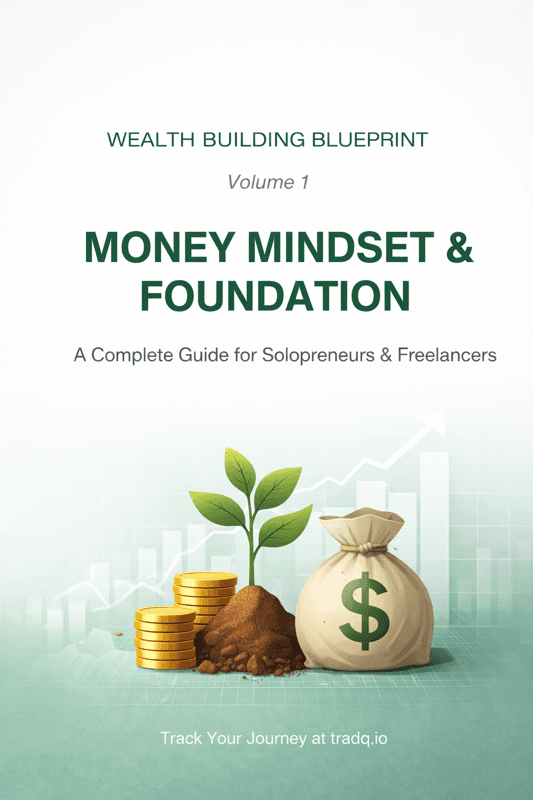
Wealth Building Blueprint Vol I - Money Mindset
Instant download · EPUB + PDF
Reprogram your relationship with money. Break limiting beliefs and develop the psychology of wealth.
Apple Pay, Google Pay and card accepted
Common beginner traps (and what we refuse to do about them)
Trap one: hoarding conviction. Reading a fifth money book before doing the first action the third one gave you is procrastination with a cover story. Two or three books in, the constraint is execution, not knowledge.
Trap two: waiting to have money to manage. Control precedes capital. Auditing your money beliefs and mapping your cash flow cost nothing, and they are the whole game at zero savings. In 2023, 4.2 percent of US households, about 5.6 million, were unbanked, the lowest recorded rate since the FDIC survey began in 2009, down from 8.2 percent in 2011 (FDIC 2023 National Survey of Unbanked and Underbanked Households, https://www.fdic.gov/household-survey/2023-fdic-national-survey-unbanked-and-underbanked-households-report). Money control starts with tools that are free or near-free: bank accounts, a written cash flow map, an automated transfer of any size.
Trap three: believing anyone who quotes you a figure. We make no income promises anywhere in the series, and you should treat that as a filter for the whole category, not just for us. A money book that names the number you will end up with is selling certainty that does not exist.
Books vs Free Content: What a Beginner Actually Needs to Pay For
The half-answer most articles give you is that free content is fine to start. Here is the full version, named plainly. Free content is genuinely enough for three jobs: understanding the vocabulary, sampling a category before you commit, and getting one good habit started, because a three-minute article can absolutely talk you into setting up an automatic transfer tonight. What free content is structurally bad at is sequence. It optimizes for clicks, so it fragments into tips, contradicts itself across publishers, and never holds you through the four-week build that actually changes a money month.
What a beginner actually needs to pay for, if anything, is a coherent system you can execute end to end: an audit you fill in, a cash-flow map with every dollar assigned, and an order of operations that assumes a zero margin. That is what a sequenced book series exists to be, and our own Wealth Building Blueprint is built exactly that way, disclosed as ours. Before you pay anyone, including us, run the filter: if the free version would get you to build the audit and the map this month, keep the money and start there. Pay only when you want the sequence pre-decided rather than self-assembled.
The 30-Day First-Month Plan
Conviction from the classics decays without a calendar, so here is the first month as four weekly moves, each with a built artifact at the end. Week one: audit what you believe about money, in writing, and set up one automatic transfer of any size. The artifact is a named list of the money rules you inherited and the one transfer confirmed in your banking app. Week two: map your cash flow on paper before the month starts, giving every dollar a written job. The artifact is the map itself, and it costs nothing.
Week three: list what you own that could eventually pay you against what only costs you money, and pick the single lever, discipline the spending leak, add a small income stream, or both, that your map says actually matters first. Week four: write the plan for month two before month two begins, because the difference between a one-month effort and a system is whether the plan survives contact with a second month. Read in this order and you end the month with artifacts rather than highlighter. If you want the walkthrough with worksheets, our How to Start Building Wealth From Zero guide covers the same sequence at /en/articles/how-to-start-building-wealth-from-zero, and the guide hub version lives at /en/guides/wealth-building.
Frequently asked questions
What are the best financial freedom books for beginners?
Start with The Richest Man in Babylon for the pay-yourself-first habit, Rich Dad Poor Dad if you need the assets reframe, and The Psychology of Money for behavior. Then add a book that ends chapters in built artifacts, an audit, a plan, a cash flow map, because the classics do not.
Can I start reading about financial freedom with no savings?
Yes, and zero savings is exactly the case these books should be judged on. Control comes before capital: an audit and a cash flow map cost nothing to build. Any book that assumes spare capital from page one is the wrong first book for a zero-savings start.
In what order should I read money books?
Conviction first, then plumbing. One short classic to build the habit, one reframe if you need it, one behavior book to protect what you build. Then a sequenced series that ends chapters in built artifacts. Do not collect five mindsets before doing one action.
Do these books promise specific financial results?
No, and you should distrust any money book that does. We make no income claims anywhere in the series. The Blueprint promises a sequence and a set of built artifacts, an audit, a plan, a cash flow map, and lets the outcomes follow your own numbers.
Want the whole series? the complete Wealth Building Blueprint bundle (4 guides in one download) or browse every Wealth Building Blueprint guide.
Before you buy, look inside:
Look inside Wealth Building Blueprint Vol I - Money Mindset →