Emergency Preparedness Checklist for UK Households
By Clarity Books editorial team · 4 min read · Updated:
A UK household emergency kit covers water, food, a torch and batteries, a battery radio, key documents, and a grab bag, aligned with the GOV.UK Prepare guidance. It is tuned to the risks most common to British homes, such as flooding and power cuts, with 999 for emergencies and 105 for power problems.
The Core UK Checklist
Build a kit you can reach in the dark. Keep bottled water and some tinned and dried food that needs little cooking, a torch with spare batteries, and a wind-up or battery radio so you can hear local updates if the power and mobile networks go down. Add a first-aid kit, any regular medicines, warm layers, and a portable power bank kept charged for your phone.
Gather your important documents, such as identification, insurance details, and a written list of emergency contacts, and keep copies somewhere waterproof. Note the key UK numbers: call 999 for a life-threatening emergency, 112 also works across the UK and Europe, 105 reaches your electricity network for a power cut, and Floodline covers flooding information. Make sure everyone at home knows them.
UK-Specific Risks
British homes face their own pattern of hazards, and your kit should reflect it. Flooding is the most widespread natural risk, affecting homes near rivers, coasts, and areas with poor drainage during heavy rain. Power cuts from winter storms can last hours or longer, and severe weather, burst pipes, and occasional heatwaves round out the list. Wildfires and major quakes are not the British concern they are elsewhere.
Check your flood risk on the GOV.UK service and sign up for flood warnings if you are in an at-risk area. Register with your energy supplier Priority Services Register if anyone in the home is vulnerable during outages. Knowing your local risk, whether that is flooding, exposure to storms, or a long rural power cut, tells you exactly what to add to the basic kit.
Build the Full Plan With the UK Guide
A kit is the start, but a plan answers the harder questions: where the household meets if you cannot get home, who checks on elderly neighbours, how you cope through a long power cut, and where the grab bag and documents live. Ready For Anything, United Kingdom Edition follows the GOV.UK Prepare approach with UK-specific steps so your plan fits how emergencies actually unfold here.
The guide breaks preparation into a short sequence you can finish across a couple of weekends rather than facing it all at once. If you travel between the UK and the continent, the Complete Ready For Anything Collection bundles every regional edition for less than buying them separately. Start with the UK edition to cover your home first, with the right numbers and risks built in. This checklist is the quick start, and our Ready For Anything series turns it into a complete, UK-specific plan.
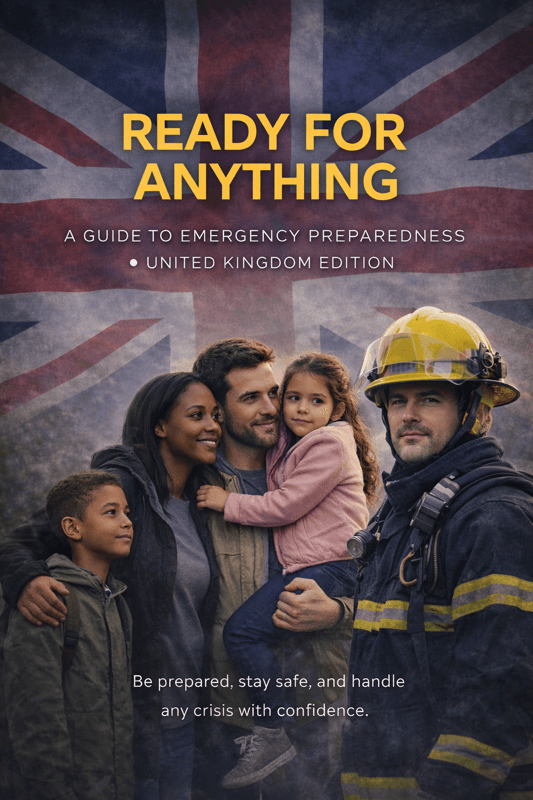
Ready For Anything - United Kingdom Edition
Instant download · EPUB + PDF
A comprehensive guide to emergency preparedness tailored for the United Kingdom. Be prepared, stay safe, and handle any crisis with confidence.
Apple Pay, Google Pay and card accepted
Keep It Current
A kit left untouched slowly goes stale. Twice a year, check use-by dates on water, food, and medicines, test the torch and radio, and recharge the power bank and any spare batteries. Update your contact list and documents whenever details change, and re-confirm your meeting point and grab-bag location if you move house or your routine shifts.
Make sure the plan lives in people, not just a cupboard. Walk the household through it, agree who does what, and check your flood warnings and local alerts before the wetter and stormier months. With the 2026 GOV.UK Prepare campaign and the national emergency-alert tests raising awareness, a kit that is current and a plan everyone knows turn a stressful event into a manageable one.
Frequently asked questions
What number do I call in an emergency in the UK?
Call 999 for any life-threatening emergency. The number 112 also works across the UK and Europe and connects to the same services. For a power cut, call 105 to reach your local electricity network, and use Floodline for flooding information rather than tying up emergency lines.
What are the most likely emergencies for UK homes?
Flooding and power cuts are the most common, alongside severe winter storms, burst pipes, and occasional heatwaves. Your kit should prioritise water, food, a torch, a battery radio, and warmth, with flood-specific steps if you live in an at-risk area you can check on GOV.UK.
How much water and food should a UK household store?
Keep at least a few days of bottled water and tinned or dried food that needs little cooking, scaling to your household size. The GOV.UK Prepare guidance favours a sensible reserve you rotate through normal meals rather than a rigid number, with extra for anyone with medical or dietary needs.
Want the whole series? the complete Ready For Anything bundle (3 guides in one download) or browse every Ready For Anything guide.
Before you buy, look inside:
Look inside Ready For Anything - United Kingdom Edition →